Nominate
DEADLINE: Materials must be submitted electronically to the Alaska Press Club by March 6, 2026. This should include a letter of recommendation and supporting materials. Email nominations to: alaskapressclubinfo@gmail.com.
The First Amendment, U.S. Constitution
Congress shall make no law respecting an establishment of religion, or prohibiting the free exercise thereof; or abridging the freedom of speech, or of the press; or the right of the people peaceably to assemble, and to petition the Government for a redress of grievances.
About the Award
The Alaska Press Club presents its annual Howard Rock/Tom Snapp First Amendment Award to spotlight an individual, group or organization in Alaska that has promoted, defended or preserved one or more of the rights guaranteed by the First Amendment.
Howard Rock was an artist and Inupiaq Eskimo from Pt. Hope in Northwest Alaska and founding editor/publisher of Tundra Times, a crusading statewide weekly newspaper that championed Alaska Native land and other rights. Rock ran Tundra Times in Fairbanks from 1962 until his death in 1976, starting the paper with Fairbanks journalist Tom Snapp, who trained Rock in journalism.
With this award, the Alaska Press Club honors the outstanding performance of an individual, group, project and/or organization for contributions to the cause of First Amendment values, either in the previous year alone or over many years.
Award Criteria
Our democratic way of life depends on the rights of free expression as delineated in the First Amendment: freedom of the press; freedom of speech; freedom of religion, freedom of assembly; and freedom to petition the government for redress of grievances. The press certainly plays an ongoing role to advance and protect First Amendment freedoms, but some acts of courage and/or persistence can and should be recognized and celebrated. The Alaska Press Club seeks to recognize such contributions by working journalists or others who uphold and defend First Amendment rights and values with courage and conviction.
Journalists certainly offer regular, outstanding examples of fortitude to spotlight, but often unsung heroes outside the working profession distinguish themselves by assisting the press, the government, academia, business and/or others in protecting First Amendment rights. Therefore, this award can recognize journalists and non-journalists (such as this award’s first recipient). The Press Club also sponsors an annual Public Service Award that recognizes only a body of work during the previous calendar year for which individuals and/or organizations nominate themselves. The First Amendment Award honors nominations by others. These are the only awards the Press Club board judges. Nominations sometimes function more like a “lifetime achievement” award in service of the First Amendment.
Howard Rock Tom Snapp First Amendment Award Recipients
2024: Antonia Commack, Amber Batts, Michael Livingston, and Marcella Boskofsky-Grounds (Advocates for Missing and Murdered Indigenous People)
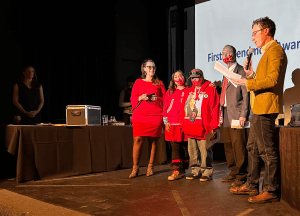
Had it not been for their efforts, the world would not have known about Cassandra Boskofsky, the third victim of serial killer Brian Smith, who preyed upon vulnerable Alaska Native women.
Smith was on trial for killing two Alaska Native women, but there was one victim whose case was not part of the trial — a woman whose lifeless images were found on Smith’s cellphone in 2019. The photos were recovered after Smith had deleted them.
Antonia Commack and Amber Batts, both bloggers and activists, learned about the existence of the images through their ongoing search of Alaska Court System records after the trial. They met in court on the first day of the trial.
Commack is a single parent with a full0time job at Data for Indigenous Justice. Batts is an advocate for Communities United for Safety and Protection (CUSP), a group made up of current and former sex workers and sex trafficking survivors.
Both women spent countless hours at the Anchorage courthouse, and hundreds of dollars of their own money, retrieving documents in the case.
Commack and Batts consulted with Michael Livingston, another MMIP activist and a retired police officer, who checked with his contacts at the Anchorage Police Department about whether there had been an artist’s rendering of the images. A short time afterwards, an artist’s composite image was made from the photographs and was eventually attached to a sentencing memorandum. Commack and Batts were the first to share these images through social media. In the filing, prosecutors argued that evidence of a third victim justified a harsher sentence for Smith, who was convicted of killing two Alaska Native women.
Within hours after seeing the photos from the court filing, Commack and Batts compared them to those of Missing and Murdered Native Women in Alaska and identified the victim as Cassandra Boskofsky, a Native woman originally from Kodiak Island. They connected with Cassandra’s cousin, Marcella Boskosfky-Grounds, who initially reported her missing in September 2019.
Teaming up with Boskosfky-Grounds, they were able to obtain a death certificate that listed her cause of death as homicide, and to find evidence that raised questions about whether police could have done more to identify her.
These awardees played an important role in at least partially lifting the veil of secrecy on a police investigation that should give us cause for concern – providing the public service of accountability.
2023: Nellie Moore (Accepted on her behalf by Lori Townsend, her daughter Liz Qaulluq Cravalho, and Irene Rowan)
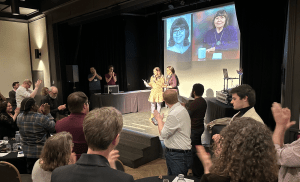
This year’s First Amendment award recipient was an Inupiaq reporter and editor whose long tenure in Alaska journalism started at KOTZ in Kotzebue. She then worked for KUAC in Fairbanks and eventually became the news director and host of National Native News for KNBA and Koahnic in Anchorage. Nellie and the journalists in the KNBA newsroom left after an ethics dispute with management and formed the non-profit Native Voice Communications, which produced independent Native news and was carried on more than 100 stations across the country. The person who nominated this year’s recipient wrote that “Transparent, ethical journalism and respectful treatment of all people who found themselves in news stories was always her standard.” She died earlier this year, but her legacy and the lessons she imparted live on.
2022: Beth Bragg
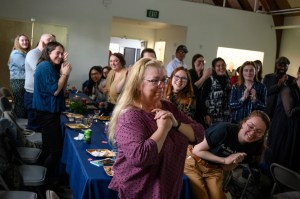
This year’s First Amendment Award winner, according to the person who nominated her, “was the best reporter, writer, story editor, line editor, thinker, interviewer and teacher I encountered. It wasn’t even close.” “She was the smartest person in every room she was in, yet she never thought so, because she was humble and she never thought journalism was about her. It was about informing and enlightening readers, giving them nuance and context, and never about gaining personal recognition … And, hey, if she could slip into the story a wonderfully terrible pun or a laugh-out-loud line, cool.”
2021: Anchorage Fire Department Video Center Director John Crabb and his chain of command, Assistant Chief Alex Boyd and Chief Doug Schrage
John Crabb received multiple nominations for the First Amendment award because of actions he took at a volatile Anchorage Assembly meeting in October 2021, as a municipal mask mandate was under discussion. As tempers flared, an appointed Anchorage government official directed Mr. Crabb to cut the live feed of the Assembly meeting while hundreds of people were watching online. He refused and referred the government official to his supervisors, Mr. Boyd and Mr. Schrage, who both upheld Mr. Crabb’s refusal to follow the official’s orders to cut the live feed. As one person who nominated him wrote, “Mr. Crabb’s steadfast refusal to cut the live feed of the public meeting in the face of the heated atmosphere and at the direction of a government official shows courage and persistence in upholding First Amendment rights and values for all citizens. The support of his superiors of his actions is equally brave in upholding the First Amendment right of the press and public to have open and transparent access to the government.”
2020: Rod Boyce, Fairbanks Daily News-Miner
This year, we had solid nominations for the First Amendment Award, with multiple nominees who did good work in advancing the cause of journalistic freedom in Alaska. That’s a good sign for our state. This year’s First Amendment Award winner is not a man known to toot his own horn very often. Over the course of a three-decade career in Alaska journalism, he was mostly happy to let his writing and his newsroom’s work speak for itself. He was an Alaska transplant from California, coming north to work for the Anchorage Times. When the Times presses stopped for good in 1992, he spent some time working at rural Alaska papers before landing at the paper where he would make his home for 27 years, the Fairbanks Daily News-Miner. For the past 12 and a half years, he was its managing editor. Perhaps his greatest contribution to Alaska journalism, however, was the cultivation of journalists early in their careers. He had a gift for finding candidates who would be a good fit not just for the newsroom, but for life in Fairbanks — which, as anyone who has lived there can attest, isn’t an easy task. As editor, he hired many reporters and editors who have gone on to make their careers in Alaska journalism and beyond.
2019: Ed Schoenfeld, retired from CoastAlaska
2017: Lisa Demer, Alaska Dispatch News/Anchorage Daily News
2016: Brian O’Donoghue, University of Alaska Fairbanks.
2015: Alexandra Gutierrez with Alaska Public Radio Network, and Jill Burke, Richard Mauer, Lisa Demer at the Alaska Dispatch News
2015: Steve Heimel, Alaska Public Media
2014: Sheila Toomey, Anchorage Daily News
2013: Dermot Cole, Fairbanks Daily News-Miner
2012: Nancy McGuire, editor and owner of the Nome Nugget
2011: Alaska Dispatch
2009: Judith & Gregg Erickson (founding co-publishers, Alaska Budget Report)
2008: Peter Dunlap-Shohl (editorial cartoonist)
2007: John McKay (attorney)
Eligibility
Any project, group, individual or individuals who have demonstrated the protection of and extension of any, some, or all of the basic rights guaranteed by the First Amendment, particularly as it relates to press freedom or free speech, could be eligible for this award. Like other First Amendment awards nationwide, nominees need not be journalists. The Eugene S. Pulliam First Amendment Award, for example, “encourages recognition of those outside the journalism profession for their First Amendment efforts and initiatives, such as, but not limited to, public officials, members of the legal profession, scholars, educators, librarians, students and ordinary citizens.”
Nominations can include supporting documentation (such as publications or other communication such as journalistic writing, artistic expression, legal writings, record of activities and so forth). Nevertheless, one letter of support or other pieces of documentation also can suffice. Information should explain the worthiness of the candidate(s) for the award. The Howard Rock Tom Snapp First Amendment Award seeks to recognize those who have demonstrated extraordinary will, character, courage, intelligence, lifetime achievement and/or integrity in the defense, promotion and protection of the First Amendment.
*Nomination letter should specify the specific actions taken to promote and preserve rights; confront and overcome barriers; and measure discernible results. Nomination should outline the overall contribution of the candidate(s) to the fortification of the First Amendment in Alaska or for public issues affecting Alaska.
*Supporting materials are encouraged but not necessary and may include published or broadcast information or other appropriate documentation.
*All entries become the property of The Alaska Press Club and cannot be returned. They may be republished for general distribution or used to publicize the award.
The award is granted upon the sole and final judgment of The Alaska Press Club Board.
 Alaska Press Club