
March 28, 2025
Alaskans,
When President Lyndon B. Johnson signed the Public Broadcasting Act into law in 1967, he said it would “enrich man’s spirit” as we pursued excellence in America. He envisioned public radio and television reporting on the “fascinating range of human activity.” He believed that education and knowledge shared through these networks could change lives.
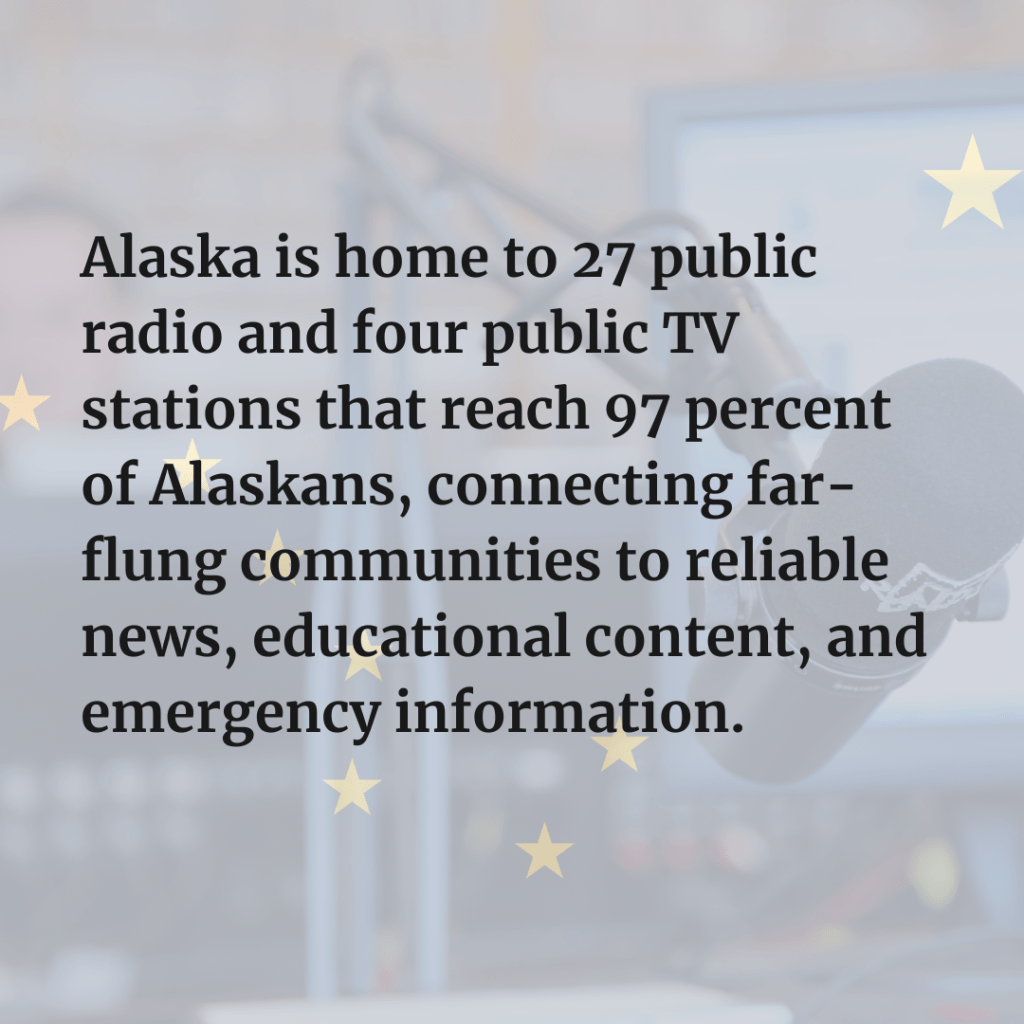
Alaskans embraced that vision. Our state has built one of the strongest public media networks in the nation, with more than two dozen stations reaching 97% of Alaskans—from Ketchikan to Utqiagvik, Unalaska to Fairbanks. When the power goes out, the internet is down, and cell service disappears, public radio is still broadcasting.
In small Alaska communities, public radio is often the only local news source—and frequently the only terrestrial radio and TV service at all. Stations provide hyper-local community announcements, weather reports, marine forecasts, and municipal meetings.
But the new head of the Federal Communications Commission, Brendan Carr, has ordered an investigation of NPR and PBS—a move that could threaten federal support for public broadcasting. Losing this support would be especially devastating for Alaska, where public media connects far-flung communities to reliable news, educational content, and emergency information.
When a massive landslide ripped down a hillside in Wrangell in the fall of 2023—killing six people and cutting off dozens of homes—public radio reporters across Alaska helped the local station’s lone reporter cover the unfolding story. They consolidated information from multiple sources and quickly updated residents on what areas to avoid, where search crews were working, and where to find temporary food and shelter. More recently, the first reporting on a fatal Bering Air plane crash came from a one-person newsroom in Nome—giving Alaskans the information they needed about what happened and what was being done.
Public radio is also where people hear moments of joy—like the story about the homecoming of an Olympic gold medalist from Homer. These stories connect Alaskans to each other and to the places they call home.
Public media provides free and accessible educational support to Alaska’s children, many of whom face significant academic challenges compared to peers in other states. Public broadcasting is the number one source of children’s educational media, making it America’s largest classroom. Shows like “Molly of Denali” introduce children to literacy skills before they ever step into a classroom.
The decline of local newsrooms across the country threatens our democracy. A 2022 University of Cambridge study found that when a community loses its newsroom, corruption increases, misinformation spreads, and voter turnout drops. In Alaska, the number of reporters at newspapers dropped more than 60% between 2000 and 2020, while radio and TV staffing declined almost every quarter between 2015 and 2020.
There aren’t enough journalists doing this work—and weakening public media would deepen the crisis.
Alaska is a unique place, and its people clearly benefit from access to trusted news, educational programming, and reliable emergency communication. The Alaska Press Club urges you to support continued federal investment in public broadcasting.
Sincerely,
Alaska Press Club Board Members
Julia O’Malley, President
Theo Greenly, Secretary
Kirsten Dobroth, Board Member
Angela Denning, Board Member
Lynne Snifka, Board Member
Eric Sowl, Board Member
Sage Smiley, Board Member
Lizzy Hahn, Student Board Member
 Alaska Press Club